Virtual Data Room Providers vs. Cloud Storage: 2026

Title: Virtual Data Room Providers vs. Cloud Storage: 2026
Week two of due diligence. Buyer’s counsel is asking for the cap table, three years of board minutes, and every IP assignment agreement ever signed. Your CFO is emailing PDFs from her personal Gmail. Outside counsel set up a Dropbox folder — and someone already deleted half of it.
I’ve seen this exact situation play out on a $180M deal in Singapore. It nearly blew up the process.
The global virtual data room market hit $4.1 billion in 2026. Not because providers invented a new problem. Because deals kept dying on infrastructure built for sharing vacation photos — and nobody wanted to admit it.
Here’s a straight comparison. What virtual data room providers actually give you, what Dropbox, Google Drive, and SharePoint fundamentally can’t, and how to think about pricing when the decision lands on your desk.

What Is a Virtual Data Room Provider?
A virtual data room provider is a company that builds secure, purpose-built software for sharing confidential documents during transactions. Not file storage. Not team collaboration. Transaction infrastructure — and the difference matters more than most people realize until something goes wrong.
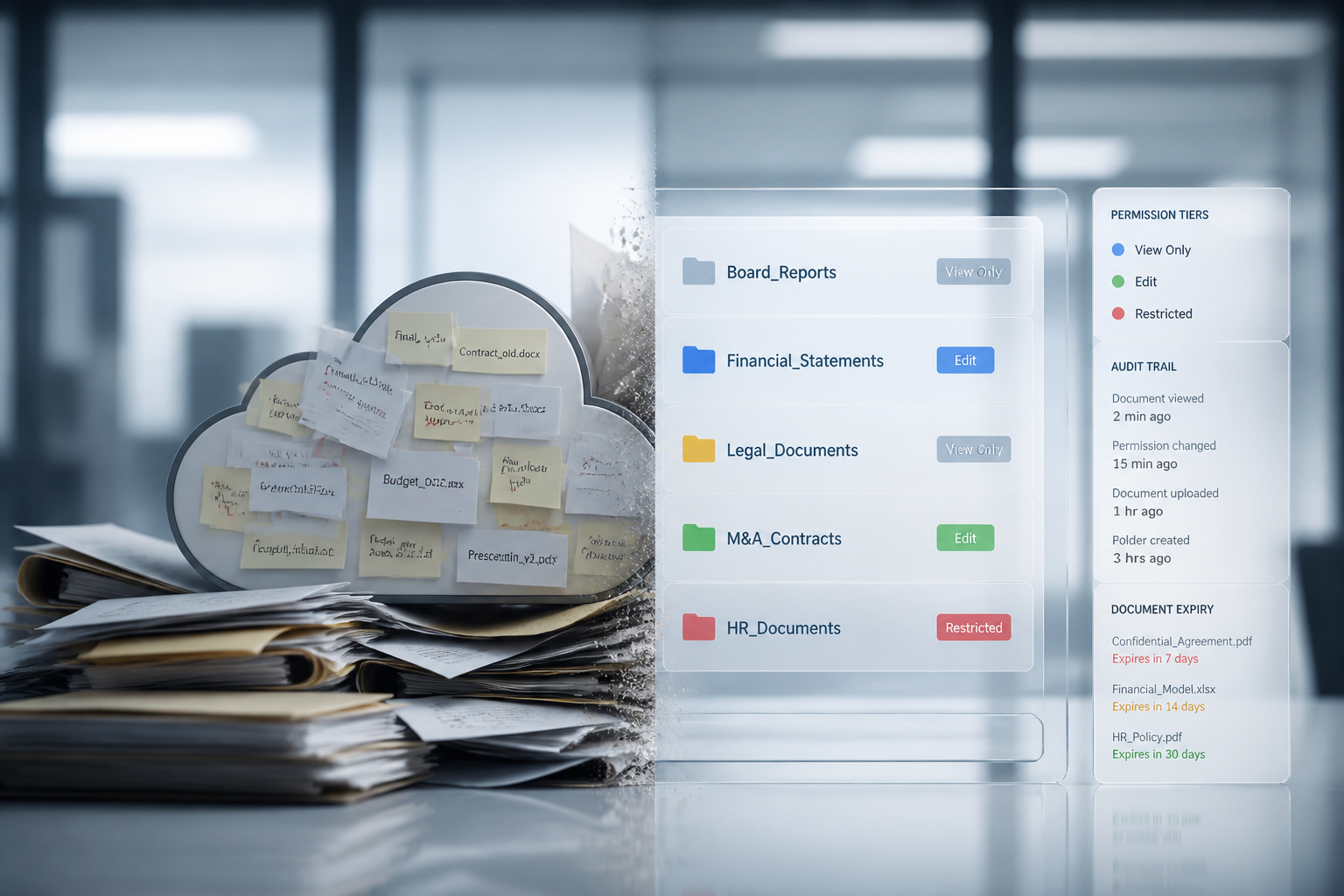
A VDR is built around the deal lifecycle. Controlled access. Granular permissions. Audit trails that would survive a courtroom. Q&A workflows between buyer and seller counsel. And the ability to revoke every access credential the moment a deal collapses — instantly, not after a three-step IT ticket.
When a PE firm running a $200M carve-out needs to know exactly who opened which document, at what time, for how long — Google Drive doesn’t have that. Dropbox doesn’t have that. SharePoint has a version of it, buried behind a full-time IT admin and a Microsoft consultant charging $300 an hour to configure it for external counterparties.
Here’s what most people miss: due diligence is adversarial. You’re sharing your most sensitive information with a party who is simultaneously your prospective partner and your evaluator. The tool has to reflect that tension. A shared folder doesn’t.
Virtual Data Room Providers vs. Cloud Storage: The Real Comparison
Dropbox, Google Drive, SharePoint — excellent tools. For internal teams. But they were never built to:
- Restrict downloads at the file level while still letting counterparties view documents in-browser
- Generate per-document engagement reports showing which investor read the financial model for 47 minutes
- Apply dynamic NDA watermarks to every PDF viewed in-session
- Auto-expire access after a set deal stage — no manual cleanup required
- Run structured Q&A between buy-side and sell-side counsel with full response threading
- Maintain an audit trail that holds up in discovery
A client — M&A partner at a London law firm — told me last month that they’d tried to run a $150M cross-border acquisition on SharePoint. Six weeks in, buyer’s counsel flagged that they couldn’t prove which version of the disclosure schedule the seller’s team had actually reviewed. The deal nearly fell apart. Not over the substance. Over the audit trail.
Most legacy VDRs are just glorified Dropbox folders with a fancier login screen. Sorry, but it’s true. And generic cloud tools? They fail even that bar.
| Feature | Purpose-Built VDR | Dropbox Business | Google Drive | SharePoint |
|---|---|---|---|---|
| View-only (no download) | ✓ | ✗ | Limited | Limited |
| Granular per-file permissions | ✓ | ✗ | ✗ | ✓ (complex setup) |
| Full audit trail / activity logs | ✓ | Basic | Basic | Limited |
| NDA watermarking | ✓ | ✗ | ✗ | ✗ |
| Structured Q&A workflow | ✓ | ✗ | ✗ | ✗ |
| Access expiry / instant revocation | ✓ | ✗ | ✗ | ✓ (complex setup) |
| AI document intelligence | ✓ (modern VDRs) | ✗ | Limited | Limited |
| Deal-ready reporting | ✓ | ✗ | ✗ | ✗ |
Virtual Data Room Pricing: What You Actually Pay
Most comparison guides go vague here. They shouldn’t. Pricing in 2026 breaks down like this:
- Entry-level SaaS VDRs — $100–$400/month. Fine for a single fundraise or a founder sharing data with eight investors. Limited storage, basic audit trails — but it works for what it is. A Series A with a small investor syndicate? This tier holds up.
- Mid-market providers — $500–$3,000/month. Per-deal or subscription pricing, real permissions, branded interface. Right for Series B+ rounds and smaller M&A. SmartVDR sits here — with AI capabilities most enterprise providers charge five times as much to access.
- Legacy enterprise providers — $10,000–$200,000+ per deal. Intralinks. Merrill Datasite. Firmex. And honestly? Most of that price reflects legacy infrastructure overhead, not better technology. You’re paying for the brand and the account manager who calls you twice a week. That’s it.
- Custom / private deployments — variable. Deployed directly into the client’s own AWS, Azure, or GCP environment. Law firms and banks can bill this back as a matter cost — turning a vendor expense into a margin line on their invoice. SmartVDR Custom is one of the first productized offerings of this kind.
Use Cases Beyond M&A
Most guides narrow this to M&A. That misses a lot of the real picture.
A Series B founder sharing financials, cap tables, and board minutes with 12 investors simultaneously — with per-investor access logs showing exactly who read the model before the term sheet conversation — that’s a fundraising data room. A commercial real estate syndication in Dubai with 40 LPs needing tiered document access tied to investment tranche? Same tool, different structure.
And beyond that…
- Litigation support — document production with integrity logs that hold up in court, not just in a partner meeting
- Regulatory filings — SEC, FCA, and cross-border compliance submissions where chain-of-custody documentation isn’t optional
- Joint ventures — two corporates sharing IP and technical specs, where both sides need to know exactly what the counterparty has seen and when
- Real estate transactions — REIT filings, commercial property diligence, syndication deal structures with complex LP tiers
The tool is the same. The structure adapts. A shared Dropbox folder doesn’t.
How to Evaluate Virtual Data Room Providers: Four Questions
When a managing partner or VP of corporate development asks me how to choose, I skip the feature checklist. I give them four questions:
- Where does the data live, and who holds the encryption keys? For cross-border deals with regulatory exposure — a Frankfurt-to-Seoul transaction, say — jurisdiction matters. Some providers hold keys on your behalf. The best modern options put control entirely in your hands.
- What does the audit trail actually show? Can you export it? Is it timestamped and tamper-evident? Would it survive discovery six months after close?
- How long does setup actually take? A virtual data room that takes three weeks to configure defeats the point. Modern AI-enhanced platforms should have you live in hours — not days, not weeks.
- What happens when the deal falls through? Can you revoke all access instantly? What’s the documented data deletion process, and who certifies it?
Most legacy providers struggle on questions three and four. Generic cloud tools fail on all four. But that’s exactly the gap purpose-built virtual data room providers exist to close.
Frequently Asked Questions
What is a virtual data room provider?
A virtual data room provider is a company that offers secure, purpose-built software for sharing confidential documents during high-stakes transactions — M&A deals, fundraising rounds, legal proceedings, and real estate closings. Unlike general cloud storage, VDR platforms are built around controlled access, audit trails, Q&A workflows, and deal-specific permissions that generic tools don’t support.
How much do virtual data room providers cost?
Pricing ranges from around $100/month for basic entry-level platforms to $200,000+ per deal for legacy enterprise providers like Intralinks or Merrill Datasite. Mid-market AI-powered platforms — including SmartVDR — typically fall in the $500–$3,000/month range, offering enterprise-grade security and document intelligence without the legacy price tag. Custom, privately-deployed VDRs are priced separately and can be billed back to end-clients as a matter cost.
What is the difference between a VDR and Dropbox or Google Drive?
Dropbox and Google Drive are general-purpose file storage tools built for internal team collaboration. Virtual data rooms are purpose-built for external, adversarial document-sharing environments — with view-only restrictions, dynamic watermarking, per-user audit trails, structured Q&A, and instant access revocation. For anything with legal or financial stakes, a VDR is not a luxury — it’s the minimum viable infrastructure.
How long does it take to set up a virtual data room for due diligence?
Modern, AI-enhanced virtual data rooms can be configured and populated in a matter of hours. AI-assisted platforms like SmartVDR auto-categorize and organize uploaded documents, dramatically cutting setup time compared to legacy VDRs or manual folder structures. Legacy enterprise platforms can take days or weeks — especially when custom configuration runs through a dedicated account manager who’s juggling twelve other deals.
Ready to run your next deal on a smarter data room? Visit SmartVDR.com to see how AI-powered document intelligence can close your deals faster.