VDR SmartVS: AI-Powered Due Diligence Deep Dive

Title: VDR SmartVS: AI-Powered Due Diligence Deep Dive
Fifty-one percent.
That’s what ION Analytics found when they surveyed deal professionals about the most painful part of M&A. Tech and cybersecurity due diligence — not financial review, not legal, not regulatory sign-off. The document grind is winning. And not because deal teams got lazy. Because the volume and complexity buried inside a modern document set has completely outpaced the tools most firms are still using.
I’ve watched senior partners at London law firms spend the first full week of a mandate just sorting folders. Talented people. Expensive people. Doing work a machine can finish before lunch.
Something is broken. Here’s what fixing it actually looks like.

SmartVS Manual Review: What Machine Learning Actually Does in a VDR
When people say “AI contract review,” they picture a smarter search box. That’s underselling it — significantly.
In a modern virtual data room for due diligence, machine learning works in distinct layers. Each one compresses time. Each one catches what a human misses at document 300 of 600.
Layer 1 — Classification. The AI reads document content, metadata, and context to place each file exactly where it belongs in the deal structure. Employment agreements don’t end up next to IP licenses. Board minutes don’t bury material contracts. Two thousand documents organized in the time it takes a junior associate to sort 200.
Layer 2 — Clause extraction. Every customer contract, lease, and license gets parsed — change-of-control triggers, termination rights, exclusivity windows, auto-renewal terms. These surface in a searchable clause library before a human reviewer reads page one. Not after. Before.
Layer 3 — Risk flagging. This is where it earns its keep. The model is trained on what “bad” looks like in transactions: IP assignments missing countersignatures, warranties that contradict representations three pages later, government consents that survive a change of control. It doesn’t just report what’s there. It tells you what’s wrong.
Layer 4 — Gap detection. The AI compares the virtual data room against standard checklists for that deal type. Missing articles of incorporation? Flagged. No executed shareholder agreement? Flagged. Three years of financials, no footnotes? Flagged. A PE firm in Chicago ran a $200M carve-out last quarter — week one, the AI surfaced 14 missing documents, including a government consent the seller didn’t even know was required. Without that catch, you’re looking at a three-week slip. Minimum. That’s not a feature. That’s deal protection.
AI Virtual Data Room: The Time Math That Actually Matters
A senior associate at a London law firm — cross-border M&A, high volume — told me this recently:
“We were spending 40 hours per deal just on initial document review. Sorting. Categorizing. Building the review matrix. The AI does it in four hours. We redirect those 36 hours toward actual legal analysis.”
That’s the arithmetic that decides whether a deal closes on schedule.
And here’s what most people miss: there’s a real difference between a legacy platform that bolted on “AI search” in 2024 and a secure data room built from the ground up with document intelligence as the actual core product. One is a checkbox. The other rewrites the entire workflow.
Most legacy VDRs are just glorified Dropbox folders. Sorry, but it’s true.
The global VDR software market hit $4.1 billion in 2026 — partly deal volume, partly clients finally asking why they’re paying senior-associate rates for document sorting. SmartVDR is built as the alternative: an AI virtual data room that treats document intelligence as infrastructure, not an afterthought. Most legacy platforms are still designed like it’s 2010. That’s a real problem when your buyer’s counsel is asking for a clause-by-clause risk summary on day one.
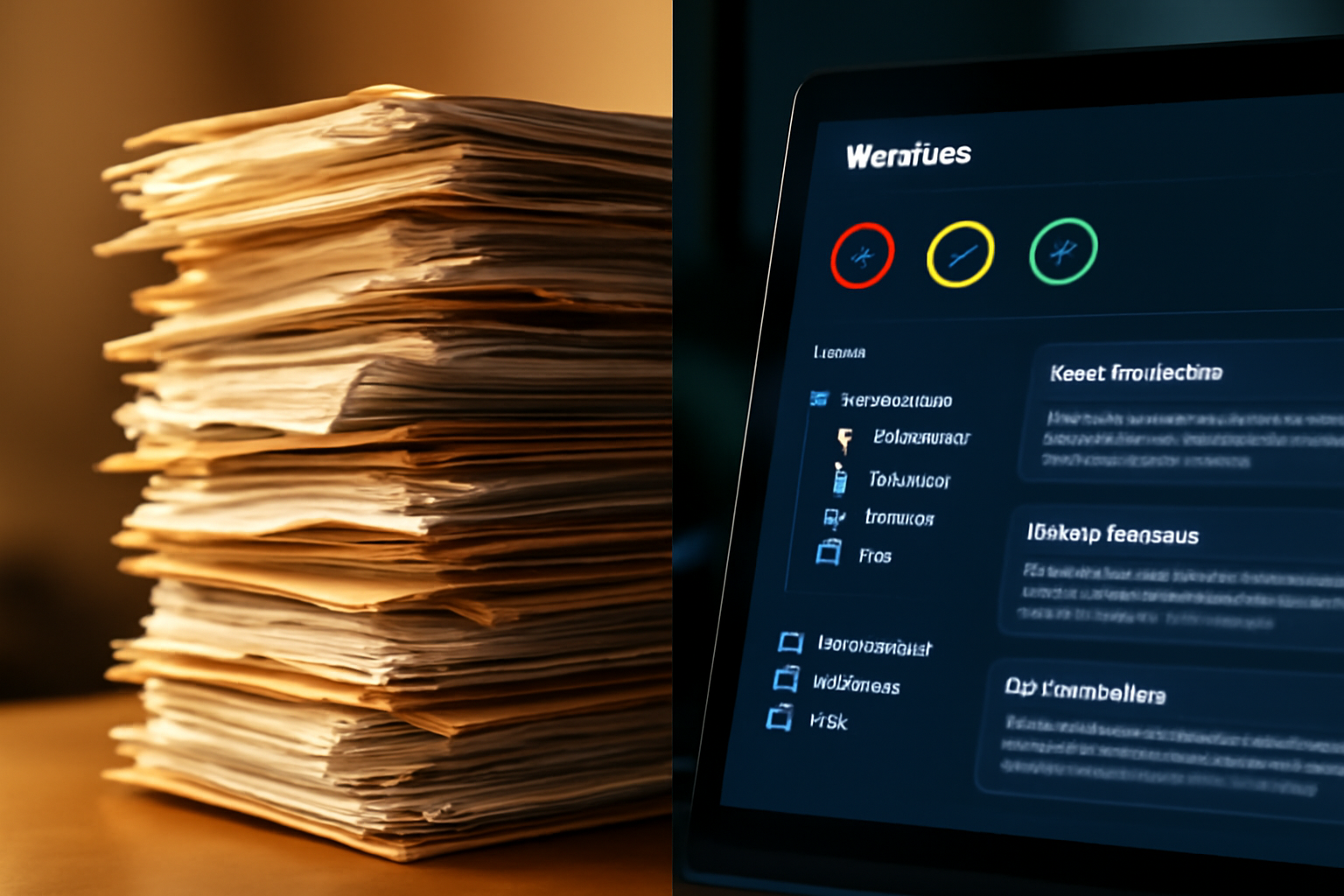
SmartVS Traditional Workflows: Three Deal Scenarios
Scenario 1 — M&A sell-side, mid-market. A corporate development team in Toronto prepares a virtual data room for M&A. AI pre-populates the folder structure, auto-categorizes 2,400 documents, and generates a readiness report — 23 gaps surfaced before the buyer even logs in. Due diligence kicks off with the room 90% organized. First-day requests drop by half.
Scenario 2 — Series B fundraising. A founder in Singapore uploads 140 documents to a data room for startup fundraising. AI validates cap table consistency, extracts key metrics, and flags two pre-seed SAFE notes that were never countersigned. Fixed before term sheet. What could have been a closing mess — the kind that makes investors nervous at exactly the wrong moment — caught in week one.
Scenario 3 — Cross-border legal review. A virtual data room for law firms handling a three-jurisdiction acquisition across the U.S., Germany, and the UAE. AI identifies governing-law inconsistencies between agreements drafted in different countries. Sixty hours of parallel human review compressed to eight.
Deal teams that have run one AI-native process don’t go back. CFOs are asking for it. General counsel is recommending it. And the founders who’ve sat through a messy diligence process once — they especially get it.
What AI Flags That Human Teams Consistently Miss
I’ve seen deals nearly fall apart over issues sitting in the data room the entire time. Nobody caught them because nobody had the bandwidth. Document fatigue is real — nobody is fully sharp at file 400 of 600.
Here’s what AI due diligence in a modern virtual data room for M&A actually catches:
- Revenue figures that don’t match the pitch deck. The inconsistency is already in the room. AI finds it before the buyer’s team does — and you want to be the one who finds it first.
- IP assets expiring within 18 months of close. A portfolio company’s core patent running out isn’t obvious until someone looks. AI looks at everything.
- Executed agreements with a missing countersignature. One party signed. The other didn’t. That’s not a binding contract — and it shows up more often than anyone wants to admit.
- Regulatory filings absent for pharma, fintech, or other regulated-industry targets. Miss one, and you’re having a very awkward conversation with the buyer’s counsel in week three.
- Auto-renewal clauses buried on page 42 of a vendor agreement. The kind that trigger unless cancelled 90 days prior. The kind nobody read because they were on document 350 at 11pm on a Tuesday.
As a Datasite alternative or Intralinks alternative, a modern AI-powered platform doesn’t just store documents. It reads them — actively, on your behalf — and flags the things that blow up a deal six weeks before close. Before they become your problem.
That’s the real value. Not faster sorting… systematic coverage that a human team running at deal pace simply cannot replicate.
Frequently Asked Questions
What is a SmartVS virtual data room, and how does it differ from a traditional VDR?
A SmartVS virtual data room uses AI and machine learning to go beyond secure file storage — it actively reviews documents, extracts key clauses, flags risks, and identifies missing files during due diligence. Traditional VDRs are repositories. An AI-native data room is a review engine working in parallel with your deal team.
How much faster is AI due diligence compared to manual review?
Based on deal team feedback, AI-powered document review can compress initial classification and review-matrix building from 30–40 hours down to 4–6 hours per deal. Risk flagging and gap detection run in parallel — work that previously required dedicated review cycles now runs automatically on upload.
What should I look for in a virtual data room for M&A due diligence?
Beyond SOC 2 certifications and permission controls, look for native AI capabilities: automatic document classification, clause extraction, anomaly detection, and gap analysis against standard due diligence checklists. Also check setup speed — the best platforms are operational within hours, not days, and don’t need a technical team to configure.
Can an AI virtual data room work for startup fundraising, not just M&A?
Yes — and it’s often more valuable at the startup stage, where founders don’t have dedicated deal counsel on standby. AI can validate cap table consistency, flag unsigned agreements, and surface financial inconsistencies before an investor’s team finds them. A clean, AI-organized data room also signals operational maturity. That matters more than most founders realize.
Ready to run your next deal on a smarter data room? Visit SmartVDR.com to see how AI-powered document intelligence can close your deals faster.