VDR Market Hits $4.1B: The AI Shift Rewriting M&A Deals

Last quarter, a mid-market PE fund was three days from signing on a $180M healthcare roll-up. Eleven bidders in the data room. Sixty-two hundred documents. And their VDR — a legacy platform they’d used for years — crashed during peak access hours. The deal slipped. The seller’s banker called. It was ugly.
That’s the backdrop for a $4.1 billion market number.
A report published last month put the global virtual data room market at exactly that — $4.1B in 2026, up sharply from two years prior. Twelve major deals tracked across sectors. Real shifts in pricing models. And accelerating AI adoption across due diligence workflows globally. The headline number is real. But what’s happening underneath it is more interesting.
There’s a genuine split forming. On one side: legacy VDR platforms that have been around since the CD-ROM era, still charging per page, still shipping clunky interfaces, still sending deal teams into customer support purgatory at 11 PM when buyer’s counsel just sent another RFI. On the other: AI-native platforms built for how deals actually move in 2026. Most legacy VDRs are basically glorified Dropbox folders with a watermark slapped on top. Sorry, but it’s true.
What the 2026 Market Data Actually Tells Deal Teams
The twelve deals tracked in the report crossed every sector — healthcare, energy, fintech, real estate, tech. What stands out isn’t volume. It’s the pattern. Every high-complexity deal had AI-assisted due diligence as a core part of the process. Not a nice-to-have. Core.
Here’s what that looks like in practice. A PE firm in Chicago closing a $200M manufacturing carve-out used AI contract analysis to surface change-of-control provisions across 340 supplier agreements — in under 48 hours. A London law firm running cross-border diligence on a European target with documents in four languages: old workflow was hire translators, wait weeks, hope nothing slips. New workflow is AI parsing, semantic search across translated materials, flagged anomalies before the first management call. The firms doing the second thing are winning mandates from the firms still doing the first.
I’ve seen both sides of that. The gap is widening fast.

The VDR Pricing Model Shift Nobody Is Talking About
The report flags something deal teams have felt for years but rarely articulate: the per-page, per-storage pricing model that legacy VDRs built their businesses on is collapsing.
Not hard to see why. When your data room bill tracks document volume, every updated financial model or amended exhibit becomes a cost event. Due diligence is iterative — documents get swapped, versioned, re-uploaded constantly. You don’t want your associates thinking about VDR billing at midnight.
Modern platforms have moved toward flat-fee deal pricing, annual subscriptions, and — this is the one worth paying attention to — custom deployment models where firms own their own data room infrastructure entirely. If you’re a law firm running twenty-plus transactions a year, the math on owning your own VDR stack versus paying a per-deal vendor is… substantial. A client told me last month they cut their annual VDR spend by sixty percent just by switching models. That’s not a rounding error.
And data sovereignty isn’t abstract anymore. A Series B startup sharing cap table details and unaudited financials with twelve investors wants certainty about where those files actually live. So does a corporate development VP in Seoul managing a cross-border acquisition where data residency law applies. The question “where is our data?” used to be a nice-to-know. Now it’s a board-level question.
Why AI in a VDR Isn’t Hype Anymore
I’ve watched this conversation shift over the past eighteen months — from “interesting feature” to “hard requirement.” The marketing language has gotten bloated enough that it’s worth being specific about what actually useful AI looks like in a live deal. Not the demo version. The week-three, compressed-timeline, buyer-just-escalated version.
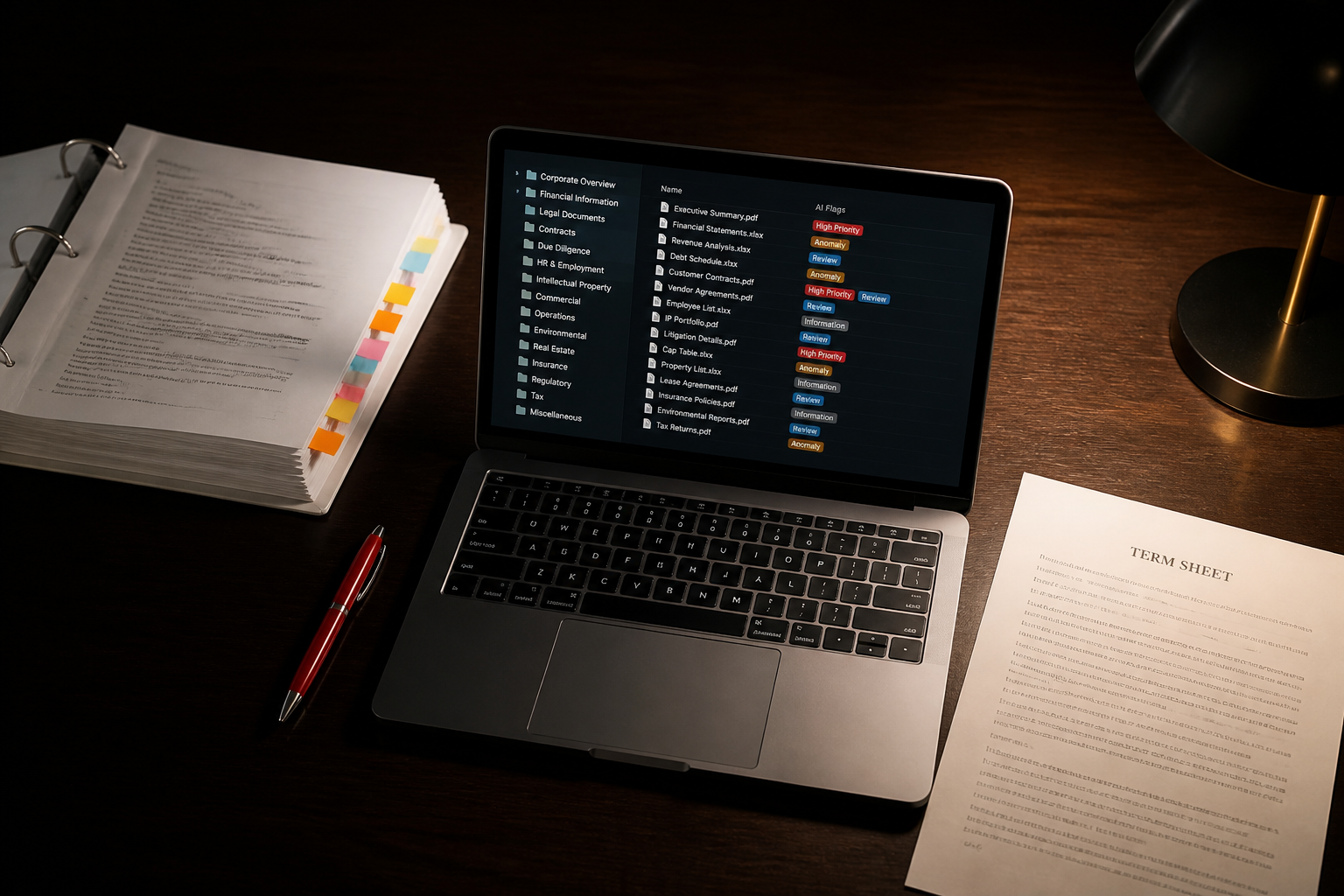
- Auto-categorization: Upload 3,000 documents from a target company. AI sorts them into the right due diligence folders — financials, IP, contracts, HR — without a paralegal burning two days on it manually. That’s real time recovered when timelines are tight.
- Anomaly detection: The system flags documents that don’t match their folder context. A contract with a non-standard indemnification clause sitting quietly in a “standard agreements” folder gets surfaced before the buyer finds it. I’ve seen that exact scenario derail a deal. Once is enough.
- Smart Q&A: Instead of buyers firing off question lists that get answered two days later, AI surfaces answers directly from the data room — with source citations. That alone compresses timelines by weeks on a competitive process.
- Missing document detection: Before you close the data room to bidders, the AI tells you what’s not there. No more buyer sending a diligence request list because your team forgot the trailing 24 months of financials. And yes — that happens more than anyone admits.
When you’re in week three and buyer’s counsel asks for that one amendment to the master services agreement you know exists but can’t locate — the difference between a 30-second AI search and a two-hour manual dig is real money. And real stress.
What This Means If You’re Choosing a VDR Right Now
The $4.1B milestone matters less than what it signals: deal teams now have real choices. The oligopoly that Intralinks, Datasite, and Firmex held for two decades is cracking. Here’s what I’d focus on heading into Q4.
- AI that’s native, not bolted on. A legacy VDR with an AI module pasted on top is still a legacy VDR underneath. Ask to see the features work on your actual document types — not a scripted demo — before you sign anything.
- Transparent, flat pricing. If the vendor won’t give you a number without a “custom quote,” that’s your answer right there. Per-page billing is a hard disqualifier for any deal running more than a few hundred documents.
- Data residency and deployment flexibility. Can you deploy in your own cloud? Do you own the encryption keys? For cross-border deals or regulated industries, this matters more than most vendors want to admit.
- Setup speed under pressure. In a live deal, you sometimes have 48 hours to get a room live. If onboarding takes a week, you’ll feel that at the worst possible moment.
- Audit trail depth. Every document view, download, and access request should be logged with timestamps and user attribution. Feels administrative — until there’s a dispute, and then it matters enormously.
SmartVDR is built for exactly this environment. AI-powered from the ground up, flat-deal pricing, and for firms that need full data sovereignty — law firms, investment banks, corporate development teams — a custom deployment option where the VDR lives entirely inside your own infrastructure. The legacy providers are scrambling to build what we already have.
The market is $4.1B because deals are happening and they need infrastructure. The question is whether your infrastructure is keeping up with the pace of the deals themselves.
Frequently Asked Questions
What is a virtual data room and why do M&A deals need one?
A virtual data room (VDR) is a secure, cloud-based platform for sharing and managing confidential documents during high-stakes transactions — M&A, fundraising, IPOs, legal proceedings. Deal teams use VDRs to control who sees what, track all document access with a full audit trail, manage buyer Q&A, and centralize the due diligence process. Unlike shared cloud storage, a VDR is purpose-built for transactions, with document-level permission controls and enterprise-grade security.
How much does a virtual data room cost in 2026?
Virtual data room pricing varies significantly by provider and model. Legacy providers like Intralinks and Datasite often charge per page or per gigabyte, which can run tens of thousands of dollars for a mid-market deal. Modern AI-powered providers like SmartVDR offer flat-fee deal pricing and annual subscriptions, making costs predictable. Custom enterprise deployments — where the VDR runs inside your own cloud or network — are now available as a productized offering for firms that need full data sovereignty or want to bill VDR usage back to their clients.
What should I look for in a virtual data room for M&A due diligence?
Prioritize native AI features (document auto-categorization, smart search, missing document detection), transparent flat-fee pricing, granular permission controls, a full audit trail, watermarking, and fast setup time. For cross-border deals, ask specifically about data residency and custom deployment options. The best virtual data room for M&A is one your deal team can actually operate without a week of onboarding — speed and usability matter as much as features in a live process.
What’s the difference between SmartVDR and legacy VDR providers like Datasite or Intralinks?
Legacy VDR platforms were built on older architecture and have added AI features as afterthoughts. SmartVDR is AI-first: document intelligence, auto-categorization, and smart Q&A are built into the core platform. SmartVDR also offers a custom deployment option — your own private VDR deployed inside your own infrastructure — which legacy vendors don’t offer as a productized product. And the pricing is significantly more competitive, with no per-page billing surprises mid-deal.
Ready to run your next deal on a smarter data room? Visit SmartVDR.com to see how AI-powered document intelligence can close your deals faster.